Showing posts with label KranjLoka. Show all posts

Thursday, October 14, 2010

Kranj, Slovenia

Fourth biggest town of Slovenia


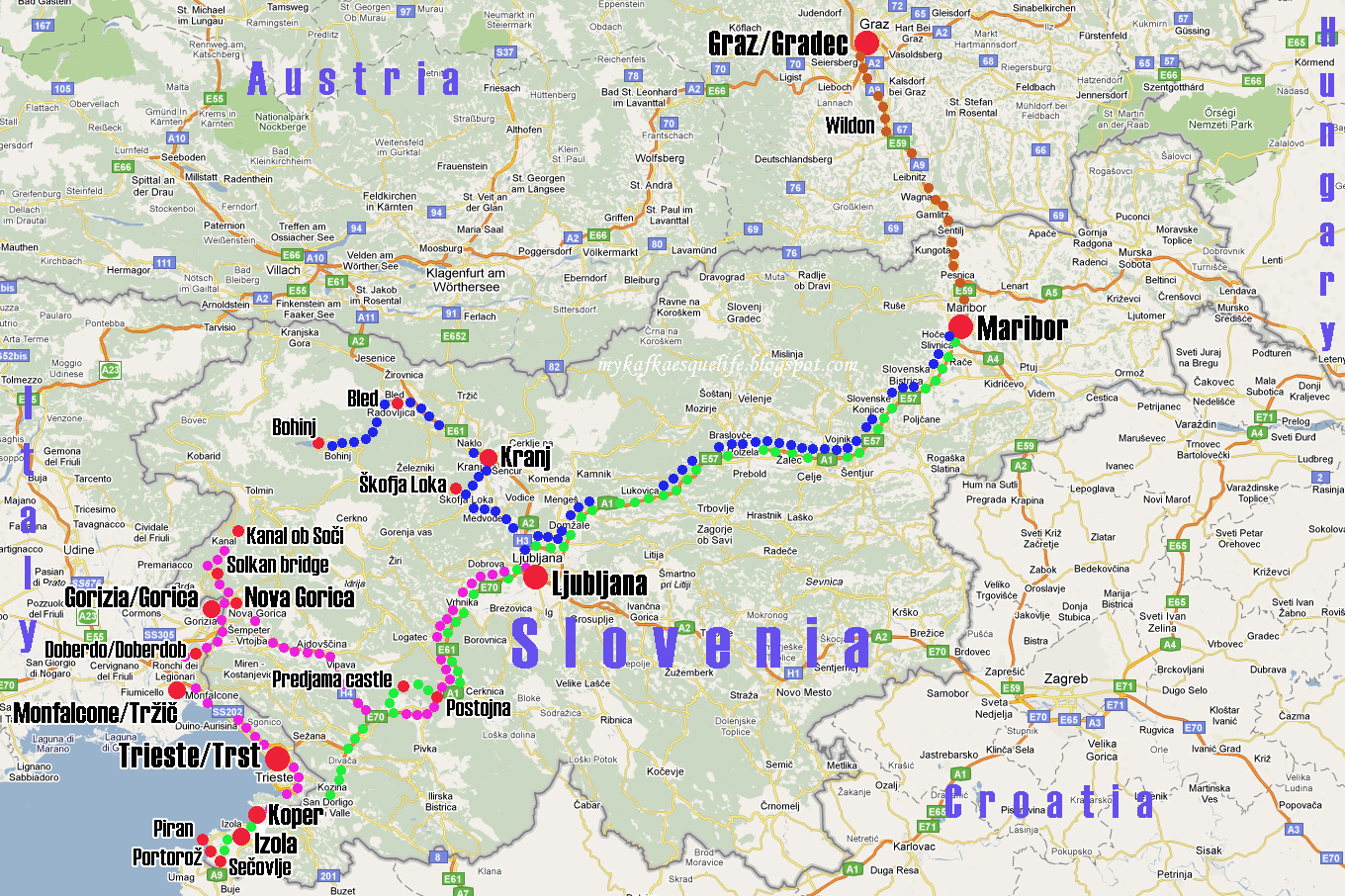
Kranj (pronounced as ) is currently the fourth biggest town in Slovenia (urban area of 54.000 inhabitants) and one of our important industrial centers. It's located 30km northern from Ljubljana and 10km away from Škofja Loka and it's the capital of Gorenjska region [click on the map to see our tours].

✰ A brief history of Kranj, the capital of Gorenjska

Kranj is a historically very important Slovenian town. The name is very old and comes from the area, which used to be called Carnia (inhabited by the Celtic tribe Carni in 2nd century BC) and later Carniola (a diminutive of the original name), a province during the Roman times. The settlement of today's Kranj was called Carnium. Old Slovenians and Old Germans, who later settled in the area, named the town Kranj and Crainburg. A written script from 1060 mentions the name Creina, during the times, when Kranj was the center of the Province of Carniola. From 1364 on (up until 1846) Carniola became a duchy and the capital town became Ljubljana and Kranj lost its significance. Nevertheless, Kranj has a lovely medieval center on a hill between the rivers Sava and Kokra. It's definitely worth a stroll, even though an hour is enough to see the most of it. Kranj was also home to many famous Slovenians, from Prešeren, our most famous poet to Plečnik, our most famous architect.

Fun fact about Kranj: In 1939 and 1944 (time of the World War II) underground corridors (Kranjski rovi) were built below the historic part and were meant as hideouts for the citizens. Today they're open to public since 2008 and quickly became a tourist attraction. The corridors are all together 1300m long. See photos here>>


Take a walk with me:

This is just before Kranj's center. We're descending (Yay!).

The center was built on top of a hill, so we had to go up again. Driving in Kranj is not easy.


✰ Our day in Kranj

We parked the car near the old center and took a walk. My girlfriend and I were so hungry, it was lunch time, so we decided to go to the first restaurant we saw. It was a cheap and good one. They mostly served Slovenian food and we ordered some things that not even I had eaten before. Both dishes were made with curd, my girlfriend had a kind of lasagna and salad, I had pancakes. It was a vegetarian lunch and I liked it very much, especially my pancakes. After an ice cream and coffee, we headed to the oldest parts of Kranj.

The medieval Kranj is very long, but narrow. Only three streets are stretched along the river banks of Sava and Kokra and you seem like you're on a small peninsula (same as in Piran). At the end, at the tip, there is a lovely view on the southern part of Kranj, which is mostly industrial.

We chose the small street over the main big one.

A lovely fountain. Historic? Probably.

The small street. Oh look, where did that head pop up from? :-P

The river Kokra flows through a canyon. View on the northern Kranj.

The center seen from the bridge over Kokra.

View on the southern Kranj.

A famous house in Kranj: Mitničarska hiša. Today a restaurant.

St. Kanzian, Kranj's cathedral.

Prešernovo gledališče (Prešeren's theatre) was redesigned by Plečnik. The arcades and lanterns are typically him.

Statue of our national poet France Prešeren. He died in Kranj in 1849.


The impressive Sveti Kancijan cathedral again.

More about Kranj in my next post. And check also photos of Kranj's cathedral.


Škofja Loka :Before [Slovenia Tour 2010] Next: Kranj part II>>

Glavni trg, Kranj


Continuing from Kranj part I, here are some more photos. This time going at the right end of Kranj's historic center to the church Sv. Rok and then back to the main square, where we started. This part is around Kranj's main cathedral, the Sv. Kancijan.

A famous fountain near the church dedicated to John Neumann.

The area around the Sv. Kancijan cathedral.

Roženvenska cerkev/Rosary church is close to the end of Kranj's historic town. The arcades were added by Plečnik, our famous architect, who redesigned Ljubljana in early 20th century.

Plečnik's arcades added to the Rosary church.

Plečnikov petelin/Plečnik's rooster. Cock would sound a bit... wrong.

Rosary church again.

At the very end of Kranj is the Church of Saint Rocco/Cerkev svetega Roka.

Saint Rocco again.

The view over the southern part of Kranj.

Going back to where we came from. Walking towards the main square.

Glavni trg or Main square is the heart of Kran's medieval center.

St. Kancian's cathedral is the tallest building in this part of Kranj.

Stari vodnjak or the Old fountain at the main square.

Prešeren street/Prešernova ulica on the way back to the car.

Kranj is a lovely small town with a picturesque medieval part well worth a stroll. The food is delicious here and there are aplenty restaurants with delicious Slovenian food and from what I saw, the prices are affordable. An hour or two should be enough to see most of the old Kranj, as well as have a tasty meal in one of the lovely restaurants.

My rating of Kranj:

Great place for photos ✰✰✰✰✰
Well preserved and clean ✰✰✰✰✰
Toilets, parking, souvenirs ✰✰✰✰✰
Friendly to tourists ✰✰✰✰✰

Kranj part I :Before [Slovenia Tour 2010] Next: Bled>>

[All photos by MKL, 2010]

Monday, October 11, 2010

Škofja Loka, Slovenia

One of very well preserved medieval towns of Slovenia


Škofja Loka (pronounced as "Shkof-ya Loh-kah" ) is a historic small town in northwestern Slovenia, close to Kranj. We went there after we spent a day in
. I had never been in Škofja Loka before, so I was very curious to see how it looks like.

✰ Funny parking incident

The town is situated on several hills and randomly spread out all over. That gave me some minor headaches, because driving through the town was a bit confusing. I found a huge parking lot of a nearby factory close to the center, but wasn't sure, whether I could park there or not. A signboard said only employees are allowed to park there. So I decided to ask a local, if it's ok to park there. I saw a young couple passing by and I asked them, but guess what? They were British and couldn't help me. They were clueless tourists like us. After I told them in English about my concern, they started to worry as well. Luckily soon after a local woman passed by and told me, that it's ok to park there, that usually nobody gets a ticket for that. Even so, I did not feel very good about the whole thing, so we didn't spend a lot of time in Škofja Loka.

Škofja Loka prides itself as a museum town.

✰ About the name Škofja Loka


Prikaži večji zemljevid
The name "Škofja Loka" would literally mean "Bishop's Loka". The original name of the settlement was Loka, which is a common Slovenian topographic name and means "meadow near water". Škofja (Bishop's) was added in the 10th century, when the Holy Roman emperor Otto II. gave the town to bishop Abraham of Freising from Bavaria, where it remained until the early 19th century.

Škofja Loka is said to have the best preserved medieval center in Slovenia. That might be true, but the buildings are not in a good state. I was a bit disappointed about that, because when you see towns like Piran and Gorica (I), where the old buildings are renovated and the streets are nicely paved, you get shocked, when you walk around Škofja Loka. Some streets are not even paved and their town square is plastered with one big piece of asphalt. And another sqare is used for traffic, it's dirty and hard to walk on, because so many cars are parked everywhere. I hope this will be improved in the future and Škofja Loka will truly become a beautiful town.

Here are my photos of Škofja Loka:

The river Sora flows through Škofja Loka.

The old stone bridge over the Sora.

Spodnji trg (Lower square) and the way to the Zgornji trg (Upper square).

Parish church of St. Jacob is one of Škofja Loka's landmarks.

Around the church.

The church's tower closeup.

Near the church.
✰ The legend of Škofja Loka's coat of arms

An interesting thing about the coat of arms of Škofja Loka is a head of an African man (read more about "blackamoor") with a crown and big earrings inside the castle. How did that happen? A legend says, that Abraham, the bishop of Freising and lord of Škofja Loka was once attacked by a bear near the town and his bondman, an African man, killed the fierce animal with a bow. In thanks for that, Abraham promised to the man, that "he will make him famous, so that many later generations will remember him." He kept his promise by putting the man in the coat of arms of Škofja Loka and subsequently in the coat of arms of the Freising Diocese.

Zgornji trg or Mestni trg is Škofja Loka's town square, the biggest and main square.

The town square is picturesque, but it could be in a better shape.

An old house on Škofja Loka's Mestni trg.

Plague monument of St. Mary (Marijino znamenje).

Martinčkova hiša, a famous medieval house in Škofja Loka.

✰ The castle of Škofja Loka

Škofjeloški grad (pron. "Shof-ye-losh-kee graht") is the castle above Škofja Loka's historic center. It was built in the 10th century. In the early 16th century an earthquake destroyed many parts and the castle had to be thoroughly renovated and partly rebuilt. Today there is a local museum with a collection of paintings and a display of the local history, especially the history of 20th century.

We didn't go up to the castle, we had no time.

The Škofja Loka castle closeup.

Škofja Loka is famous for the annual Škofjeloški pasijon (see some photos here).

The Capuchin monastery.

My girlfriend.

Spodnji trg (Lower square) full of cars and not really neat.

Another view of Lower square.

My rating of Škofja Loka:

Great place for photos ✰✰✰✰✰
Well preserved and clean ✰✰✰✰✰
Toilets, parking, souvenirs ✰✰✰✰✰
Friendly to tourists ✰✰✰✰✰

Ljubljana castle :Before [Slovenia Tour 2010] Next: Kranj>>

[All photos by MKL, 2010]